Thursday, February 08, 2007

Quest Diagnostics


Quest Diagnostics is one of the leading diagnostic and testing companies providing information services to doctors, hospitals, and managed care organizations.

Quest has approximately 150 laboratories and 2000 patient service centers. It processes over 140 million requisitions per year. At present, routine testing generates about 78% of revenues. The company is based in Teterboro, NJ and GlaxoSmithkline owns about 21% of the common stock.

Although, United Health has decided to use Lab Corp of America as its national provider, a position that Quest enjoyed previously, it is uncertain how negative this will be to the revenues of Quest. Although shares have fallen about 15% since Septenber 2006, I feel that the drop in shares, combined with the high ROIC provide an enticing entry point.

I haven't bought any shares of Quest but I am certainly considering the stock at this point.

I am continuing to research the stock at this point and will provide my new findings soon.

Thursday, January 25, 2007

10 years later

Somehow, I remember 1997 like yesterday. The cliché "time flies" truly is a cliché.

What is noteworthy and hopefully useful to people of all ages is that over those 10 years I have truly come to appreciate the power of compounding.

Take a look at the prices of the following comapnies in my portfolio on January 26th 1997:
Stock 19972007 % annual return
JNJ $24.62 $66.68 17.08%
AIG $27.62 $68.89 14.94%
NVS $25.88 $58.26 12.56%
BRK.B $1155 $3585.91 21.05%


It is interesting to note that, the stock that I least followed during that period was BRKB (Berkshire Hathway B) and it delivered the best return. My (Heartburn/Profit)% was pretty low with Mr. Buffett's company.
There is something to be said about patient and disciplined investing. You don't have to be a genius, what matters is the ability to maintain temperament, follow good companies, and pick them up when they are not in vogue.
Sounds easy right! However, I have found that to stick with that idea for 10 years is the hardest part.

Eat your beer bottle!

Don't you just hate it when this happens? You finally discovered the most hated stock that the "lemming crowd" avoids. You buy into your research, but learn it the hard way that what you lack is temperament. (Oh! by the way as an affirmative you find that Mr. Buffett holds about 5% of the company.)

Investing boils down to one word "discipline". I will rephrase that, "life is really about discipline". Not to get too philosophical, over the years I have found that, common sense, patience, and probability (wherein an outcome is to a great extent on your side) are factors that really matter in investing. Most human beings are frail and susceptible to the vagaries of their own emotions and their environment. To some extent, the ups and downs in the market are mere reflections of our mood fluctuations.

First and foremost, (taking the liberty to use the opposite sex as an analogy to a stock) I think it's hilarious how Wall Street portrays the so-called "unattractive" woman. She was never ugly to begin with, so simply combing her hair and wearing a push-up bra turns her into a sex bomb!
When we compare this to a stock, it seems that thanks to several upgrade spells cast by the analysts, a stock magically rises from the dead like a gorgeous babe.

I bought into one such "shrek", Anheuser Busch (BUD). Back in late 2005, at $43 BUD seemed a bargain and when I sold it for $48 after 6 months, I thought a return of approximately 12% (without dividends) was excellent.

BUD generated double digit returns of approximately 13% in EPS growth over the last 10 years and has captured about 50% of the US market (a wide moat, or a competitive advantage business in my view). Interestingly, valuation has not kept pace with earnings growth. Today, the company trades around $51 about 12% below my estimated fair value my of about $60. . However, the certainty that the estimated fair value will be achieved without losing much sleep is what makes the stock more attractive to me rather than those upgrades.

The fact that I sold it for $48 and did not wait longer demonstrates my temperament in this regard. As someone said, I think it is "time to eat the proverbial beer bottle!"

Anyway, doing nothing or as one of my friends says colloquially "fuckin' the dog!", sometimes makes more sense.

Friday, December 22, 2006

Missed Opportunities of 2006

Although 2006 was fantastic w.r.t my returns, my (Finance Obsession/ROI) ratio was not adequate. I suppose nothing is.
Anyway, as I analyzed my 2006 performance I realized that it was an year to pick low hanging fruit, i.e. a lot of good companies were bargains within plain sight. However, I seem to prefer making money the hard way. As I reviewed the spreadsheets, filters, and analysis that I meticulously maintained on a weekly basis, I rued several missed opportunities, such as:

1. Sysco (SYY) around $28 in August 2006. I had it on my radar, Trading around $36.65 today, this could have been a 22% return.
2. Walgreens (WAG) around $40 as recently as late November 2006. Somehow, I couldn't pull the trigger even though I realized that the whole Walmart entry into the retail drug industry was overblown. This was an example of a low risk 15% return in two months.
3. Tyco (TYC) around $26 was an incredible bargain at 13 times free cash flow back in June 2006. However, I decided to wait for a more opportune moment, which transpired to be a missed one. Anyway, this was another example of a low risk 15% return.
4. Microsoft (MSFT) around $22 back in June 2006. This was sick, I don't know how I managed to ignore a company with incredible cash flows and a host of new products such as the Windows Vista, XBox, and Zune. It is a cash cow and this is another no-brainer for a 31% return.

When I quantified these returns in absolute dollar terms, I realized that:

If I had bought 1000 shares of each of the above companies around their 52 week lows, which I had monitored very closely and bought them without chickening out, I could have made a return of 24% without including dividends. An absolute dollar amount of $27, 650. My frenetic trading in derivatives produced approximately $25,000, including some significant losses and heartburn. Although a return of close to 100%, I think the former approach would have helped me focus on other things in life while making money.

So, in my humble opinion patient investing that focuses on value will trump the interest to play dice.

Wednesday, November 22, 2006

Is Google "Darth Vader"?

Google Inc. (GOOG) shares soared past $500 USD for the first time the day before...I pondered, how big can Google get before we realize that it is as villianous as Vader....

I admire Google, they turned search into a four letter word i.e. "a dime" without being a pain. Internet advertising is no more a bothersome popup, or a flashing image on a website, an unobtrusive experience for the surfing masses and free cashflow to Google. Vader figured out a way to monetize billions of searches without being intrusive while making us yell "I Googled it!".

Google collects an estimated 25% of all U.S. internet ad revenue and is encroaching traditional media such as newspaper and radio. With the acquisition of YouTube, and the whole advertising/media tilt, I feel the company will start to face its share of public relation challenges, despite it's "do no evil" mantra.

Growth potential is fantastic, however, such metrics seem to be priced into the companies current valuation. With a Price/Cashflow North of 86 and a Price/Sales of approximately 25, I think it is time for the "Revenge of the Sith". In this case, Mr. Market.

As the old maxim goes, anything that is too good to be true is, "Too good to be true!"

So, if you hear your favorite analyst on a TV channel such as CNBC, etc. touting "Vader" as a must have, I would say "caveat emptor".

IMHO, Google's business is progressing at a gallop, but it's stock price seems to be traveling at "Mach" speed. When stock prices outpace the business, you have to understand that the party cannot last for too long and that it is time to take some "moolah" off the table.

Tuesday, November 07, 2006

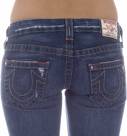
My "True Religion" is Capitalism

Ya, that's right. It is not Judaism, Hinduism, or anything more exotic. It is old-fashioned, conservative, "true religion" i.e. "Capitalism" .

When my "true religion" does not live up to its expectations, I have no choice but to renounce and convert to agnosticism and not some other form of "Opium for the masses!".

Today "True Religion" the ecstasy (E) of the town, gave back $4.2 in after-hours (approximately 22% down). When the street expects 44 cents per share and the company can only muster an ice-cold, thawing 35 cents a share, you are not going to get converts, but a bunch of agnostics.

Stocks such as True Religion (TRLG) thrive on growth, their current price is a mere reflection of discounted future cash-flows. When such growth expectations fall short by a wide margin, nasty holes in the denim are the only things that remain in vogue. My friend, that in a nutshell is Wall Street.

True Religion a Los Angeles based company, founded by the husband and wife pair of Jeffrey and Ken Lubell was based on their love for music (rock, hip-hop & R&B) that translated to denim apparel; They pay attention to fashion-forward consumers and deliver innovative , hand-sanded washes, and trendsetting lines. I personally think their Jeans are amazing! However, some friends of mine say "So what, it's just a denim!" I say, your choice of denim can be a rubberstamp for life! I am exaggerating! However, I think, I make my point with some!

Not just investors, Heidi Klum, Usher, and the cast of the Desperate Housewives subscribe to that thought process. In addition to celebrities, some of the world's well known retailers such as Barney's of NY, Harrod's of UK, L'eclaireur of France, and B'2ND of Japan, etc. have decided to extend shelf space.

Although, I like their Jeans, cerebral me says that it is really hard for companies to sustain fashion statements over extended periods of time. The problem is that fashions blow hot and blow cold, and for companies to keep pace with the vagaries of a consumer is very difficult. As they say "One Robin doesn't make a spring".

I think True Religion shares have gotten somewhat ahead of the business and the street is starting to sober up. In my opinion this will be a repeat story with many of the specialty retailers in the New Year. As the US consumer comes to grip with more mundane issues such as monthly mortgage payments, credit card bills, and shopping at Costco, the importance of making a fashion statement with True Religion will become somewhat less significant.

It is high time that prudent investors start taking taking some money off the red-hot specialty retail sector table.

Saturday, November 04, 2006

Guess which stock made u some mad money?

I hope you guessed right! It is "Guess"!

GES for you home gamers. This stock is on a tear since 2003. Guess seems to be the "True Religion" of it's avid shareholders, rising from a measly $3 per share in 2003 to its current lofty $62 per share price. I thought specialty retailer's stocks (i.e. Guess GES, True Religion TRLG, etc.) were as washed-up as their jeans but I "Guess" I have been proven wrong.

At this point, valuations on Guess seem to be stretched farther than the rubber band on my Sunday New York Times. With a Price/Cash Flow of around 20, I think we are close to "yield point". I have to admit the annual growh in revenue, eps, operating margin for Guess are not shabby, 31% rev. growth, 120% eps. growth, 7.8% operating margin growth respectively. These growth numbers seem to have been adequately priced into the stock at this point.

On October 14th in my article (Stocks Climb Again), I had mentioned that Guess was starting to look overvalued at $56 per share, my opinion at $62 per share is not any different. When you see stocks generating 15% returns in a mere month, you know that the "guess" theory is in vogue rather than plain old common sense. Wall Street is following Pascal's statement "The heart has it's reason, that reason knows not of".

I do like Guess' growth/strategy, higher-margin sales in Europe, market penetration in Germany, Asia, etc. However, I am starting to wonder if the abnormal returns in the stock price can also be attributed to a huge growth in the short-position of the stock over the last year. Are we starting to look at the "Pigeon Hole" principle in action here? Pigeons can only be happy as long as there are enough pigeon holes. I might add, it gets a bit crowded otherwise.

An old adage I would consider worthy of the current environment is "Anything too fashionable must be close to obsolescence!"

Disclosure: I don't have any position in Guess (GES) nor True Religion (TRLG). However, I am considering buying some puts on Guess (GES) if it goes any higher.